7 Days in Gansu: The Route With Room to Breathe
Seven days is where Gansu opens up. You can cover the full Hexi Corridor and add either the Tibetan monastery loop through Xiahe or the eastern cave-art detour through Tianshui. The pace shifts from 'efficient' to 'spacious,' and the trip starts to feel like a real journey.
The route at a glance
7 Days in Gansu: The Route With Room to Breathe
Seven days is the sweet spot. It is enough time for the classic corridor plus one meaningful detour — either south to Xiahe for Tibetan monastery culture and grasslands, or east to Tianshui for Maijishan's cliffside grottoes and a different cave-art experience. You are not rushing. You are not padding. You are traveling at the pace the province rewards.
Two strong route shapes
Option A — The Monastery Loop: Lanzhou → Xiahe (2 nights) → back to Lanzhou → Zhangye → Jiayuguan → Dunhuang. This is the most popular 7-day shape because it gives you both the desert corridor and the Tibetan highlands. The contrast between Labrang Monastery's incense and chanting and Dunhuang's desert silence is one of the best rhythm shifts in Chinese travel.
Option B — The Cave Art Route: Lanzhou → Tianshui (1-2 nights for Maijishan) → back to Lanzhou → Zhangye → Jiayuguan → Dunhuang. This version works best for travelers who care deeply about Buddhist art and want to see how it evolved from the Wei dynasty at Maijishan through the Tang at Mogao. It is a more niche interest, but for the right person, it is the trip of a lifetime.
Both options use Lanzhou as a pivot point. Yes, this means passing through Lanzhou twice. That is not a bug — it is the most efficient routing in a province shaped like a long corridor with a southern spur. Use the second Lanzhou stop as a recovery day: do laundry, eat well, reset before the desert push.
Option A day-by-day: the monastery loop
Day 1 — Lanzhou: Beef noodles, provincial museum, Yellow River walk. Evening food crawl. Sleep Lanzhou.
Day 2 — Lanzhou → Xiahe: Morning bus or hired car to Xiahe (4 hours through increasingly beautiful mountain and grassland scenery). Afternoon: walk the Labrang Monastery kora (prayer wheel circuit) at a slow pace — it takes about an hour and is the best orientation to the town. Evening: Tibetan café, yak butter tea if you are curious. Sleep Xiahe.
Day 3 — Xiahe: Morning: monastery interior visit, monk debate viewing if the schedule aligns. Afternoon: Sangke Grasslands — hire a car for a couple of hours, visit a Tibetan family tent if offered, photograph the yaks and the wide sky. Evening: return to Xiahe, try Tibetan momo (dumplings) or thukpa (noodle soup). Sleep Xiahe.
Day 4 — Xiahe → Lanzhou → Zhangye: Morning return to Lanzhou. Afternoon train to Zhangye (3 hours). Evening: settle in, light dinner, prepare for early Danxia sunrise. Sleep Zhangye.
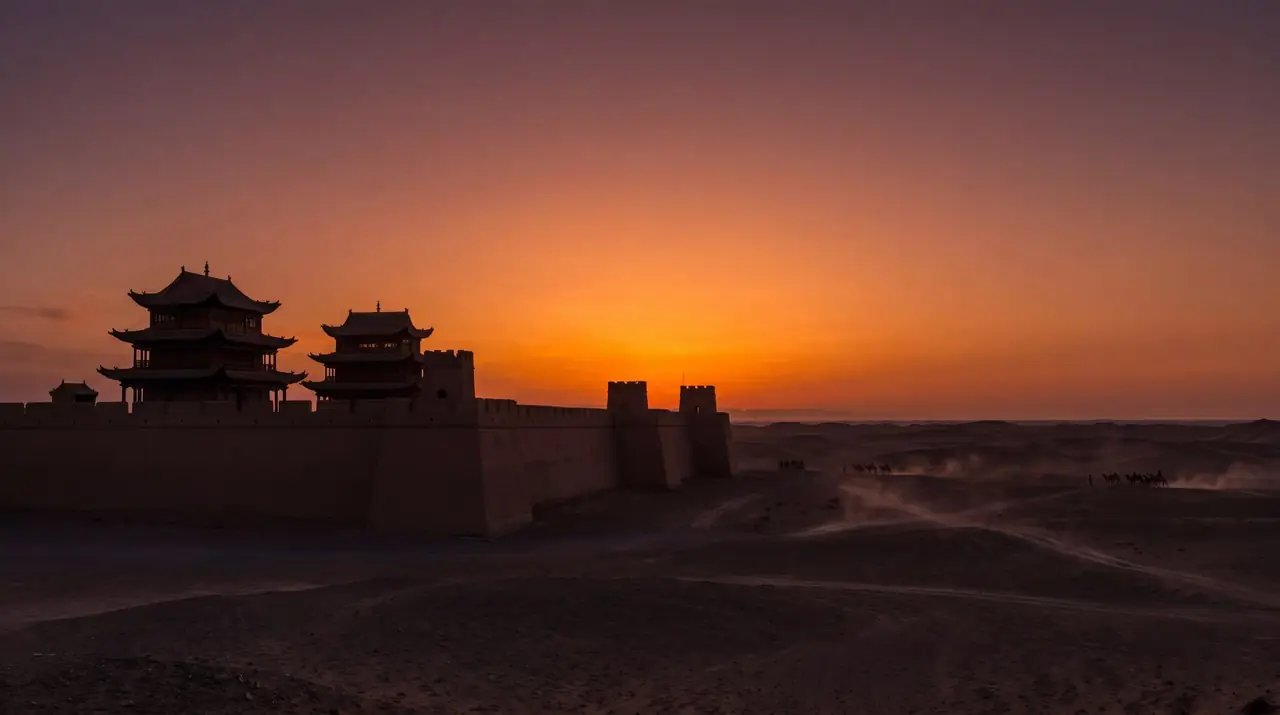
Day 5 — Zhangye → Jiayuguan: Sunrise at Zhangye Danxia. Midday train to Jiayuguan (1.5 hours). Afternoon: fortress visit. Sleep Jiayuguan.
Day 6 — Jiayuguan → Dunhuang: Morning Overhanging Wall or Wei-Jin Tombs. Midday train to Dunhuang (2.5 hours). Late afternoon: Singing Sand Mountain for sunset. Sleep Dunhuang.
Day 7 — Dunhuang: Morning Mogao Caves (book well ahead). Afternoon: Dunhuang Museum or Yangguan Pass. Evening departure or sleep Dunhuang for an early flight out.
Why this pace works
The 7-day route gives you two 2-night stops (Xiahe and Dunhuang) which changes the trip's emotional rhythm. Instead of packing and moving every single day, you have stretches where you can leave your bag in the room and just be in a place. That matters more than most itineraries admit.
The Xiahe section in the middle of the trip functions as a palate cleanser. After Lanzhou's urban energy and before the desert corridor's heat and scale, you get two days of high-altitude quiet, monastery rhythm, and a completely different cultural register. The trip would be flatter without it.
The travel days are spaced so no single day is consumed entirely by transfers. The longest single move is Lanzhou to Xiahe (4 hours), and that drive is scenic enough to count as part of the experience.
How to decide between Xiahe and Tianshui
Choose Xiahe if: you want cultural variety, you care about Tibetan Buddhism, you want green highland landscapes to break up the desert, you are okay with altitude (2,900m), and you want the trip to have a spiritual or reflective dimension beyond sightseeing.
Choose Tianshui if: you are specifically interested in Buddhist cave art and want to compare Maijishan with Mogao, you are entering Gansu from Xi'an (Tianshui is only 2 hours by train from Xi'an), you want to avoid altitude concerns, or you prefer a route that stays entirely on the main rail corridor.
If neither strongly pulls you, I lean toward Xiahe for first-timers. The cultural contrast makes the trip more memorable, and the grasslands offer a visual break that the desert-dominated corridor benefits from.
Related questions

FAQ
7-day Gansu itinerary?
This comprehensive 7-day itinerary adds Tibetan culture at Labrang Monastery and the Maijishan Grottoes to the classic Hexi Corridor route.
Read answer
FAQ
How to get around Gansu?
Gansu's transportation network has improved dramatically with high-speed rail connecting major destinations. Here's how to navigate the province.
Read answer

FAQ
What to eat in Gansu?
Gansu's cuisine reflects its position on the Silk Road, blending Chinese, Hui Muslim, and Tibetan influences into unique and delicious dishes you won't find anywhere else.
Read answer

FAQ
Best time to visit Gansu?
Gansu's continental climate means dramatic seasonal variations. Understanding the weather patterns will help you choose the perfect time for your visit.
Read answer
Go deeper with guides

City Guide
Xiahe Travel Guide: Labrang, Grasslands, and the Right Pace
Xiahe works best when you give it time for monastery rhythm, altitude adjustment, and the quieter parts of town beyond the checklist.
Open guide
Destination Strategy
Tianshui and Maijishan: A Strong East Gansu Detour
Tianshui is not the province's headline city, but Maijishan makes it one of the smartest detours for travelers who care about cave art and quieter historical sites.
Open guide

Booking Guide
How to Book Mogao Caves Tickets Without Wasting the Trip
Mogao is one of the few places in Gansu where poor booking timing can genuinely weaken the trip, so it is worth planning this stop properly.
Open guide
Relevant destinations
Destination
Dunhuang Mogao Caves
Ancient Buddhist cave temples with exquisite murals and sculptures along the Silk Road.
Open destination
Destination
Zhangye Rainbow Mountains
Breathtaking colorful mountain formations known as Rainbow Mountains.
Open destination

Destination
Jiayuguan Pass
The westernmost end of the Great Wall, known as the Greatest Pass Under Heaven.
Open destination

Destination
Labrang Monastery
One of the most important Tibetan Buddhist monasteries outside Tibet.
Open destination
Destination
Lanzhou
Capital city of Gansu, gateway to the Silk Road on the Yellow River.
Open destination
Want this itinerary adapted to your dates?
Send us your available days and rough priorities, and we can help tighten the route around real constraints.
Best fit if you already know your dates, route draft, or must-keep stops.