Gansu With Friends: Group Dynamics, Cost Splitting, and Keeping the Vibe Right
Gansu with friends can be the best version of the trip — shared costs, shared discoveries, someone to split that whole lamb with. But group travel also amplifies every planning weakness. The route needs to be clear before you arrive, because democratic decision-making on the ground in a foreign province is not as fun as it sounds.
Who this page is for
Gansu With Friends: Group Dynamics, Cost Splitting, and Keeping the Vibe Right
A group trip through Gansu has enormous upside. You split driver costs. You order half the menu and actually finish it. Someone remembers the sunscreen when you forget. Someone else figures out the train ticket machine while you guard the bags. But group travel also has a physics problem: the more people, the slower everything moves. This page is about designing a route that takes advantage of the group without letting the group become the weakest link.
What group travel does well in Gansu
Cost efficiency. Private cars, which are the best way to reach places like Xiahe, Mati Si, or the Gannan grasslands, become dramatically cheaper per person with 3-4 people. A 600-yuan day driver split four ways is 150 yuan each — less than a mediocre hotel.
Dining. Gansu food is built for groups. Whole lamb platters, shared hot pots, banquet-style Hui meals — these are experiences that solo travelers and couples simply cannot access. Four people can order eight dishes and taste everything.
Problem-solving bandwidth. Someone handles tickets, someone navigates, someone finds the restaurant, someone deals with the hotel check-in. The cognitive load of foreign travel drops significantly when distributed across a competent group.
Shared memory. The inside jokes, the wrong turns, the accidental discovery of a night market stall that becomes the trip mascot — these are the things that make a group trip stick in memory longer than any individual sight.
What usually goes wrong
Decision fatigue. If the route is not locked before arrival, every morning becomes a negotiation: what time to leave, where to go, what to eat. Group democracy sounds noble but in practice it burns time and patience.
Energy mismatches. One person wants sunrise at Danxia. Another wants to sleep until 10. Both are valid, but unresolved, this becomes resentment. The fix: agree in advance that the group does not have to do everything together. Splitting for a morning or an afternoon is fine.
Money awkwardness. Someone pays for the driver. Someone else covers the hotel. Someone grabs the restaurant bill. By day five, nobody remembers who owes what. Use Splitwise or a shared note. Settle up every two days rather than waiting until the end.
The weakest link problem. A route designed for the fittest person in the group will exhaust everyone else. A route designed for the most cautious person will frustrate the adventurous. Design for the median, not the extremes.
Group route: 7 days that keeps most people happy
Day 1: Lanzhou. Shared beef noodle breakfast, museum (people can move at their own speed), riverfront walk, group dinner at a Hui restaurant where you can order big.
Day 2: Train to Zhangye. Afternoon Giant Buddha temple. Group dinner — this is a good city for a shared hot pot or lamb feast.
Day 3: Zhangye Danxia in the morning. The group can split across different viewpoints if energy levels diverge. Afternoon: Mati Si (hire a car, the group split makes this affordable).
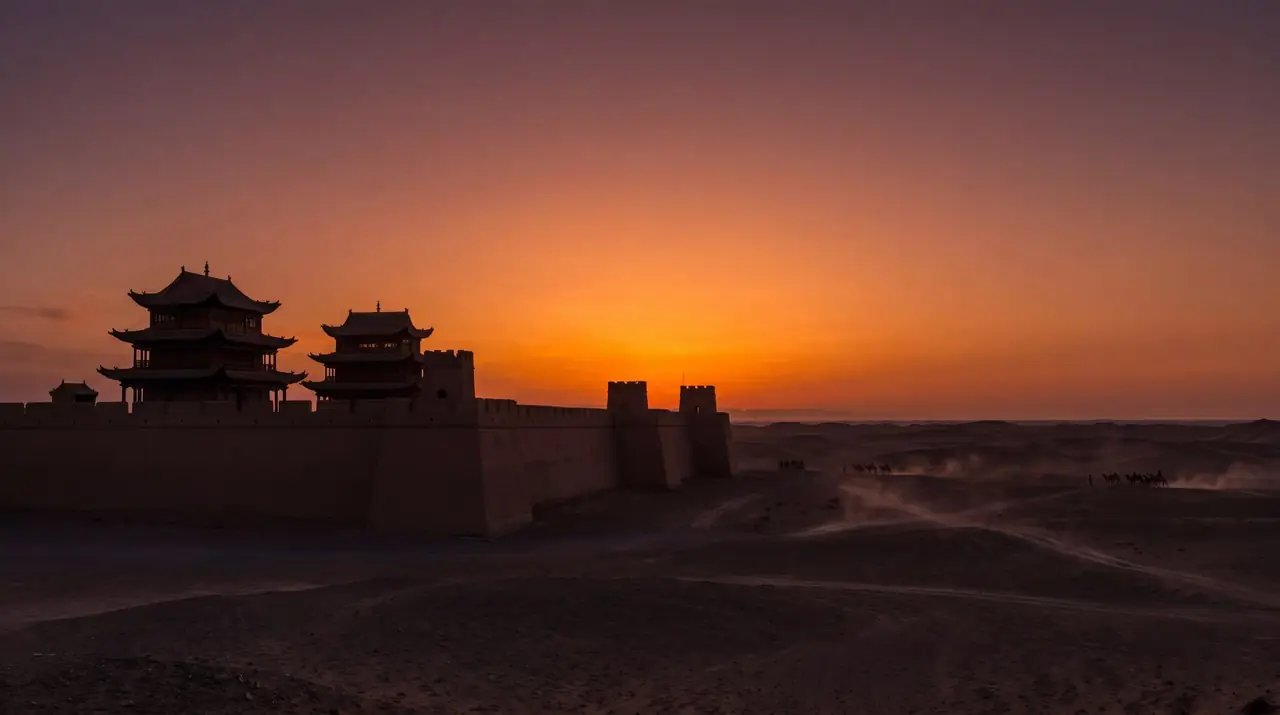
Day 4: Train to Jiayuguan. Fortress and museum. The fortress is large enough that subgroups can explore at different speeds.
Day 5: Train to Dunhuang. Rest. Night market as a group — this is peak group travel: wandering stalls, pointing at food, sharing everything.
Day 6: Mogao Caves morning (booked as a group, same time slot). Rest. Late afternoon: Singing Sand Mountain — dune running, camel rides, group photos against the desert.
Day 7: Flexible. Departure.
Practical group notes
Book trains as a group. High-speed rail seats sell in blocks. Book early and try to get seats together. Even if separated, trains are clean and comfortable.
Designate one person as the lead for each function: one for transport, one for food research, one for hotels. Rotating responsibilities prevents one person from becoming the group's unpaid travel agent.
Have a group chat with saved Chinese names for every hotel, station, and key site. If the group splits, everyone has the same reference materials.
Agree on a daily start time in advance — 8:30 AM is realistic for a group trip. Earlier than that and you are testing friendships.
Related questions

FAQ
7-day Gansu itinerary?
This comprehensive 7-day itinerary adds Tibetan culture at Labrang Monastery and the Maijishan Grottoes to the classic Hexi Corridor route.
Read answer
FAQ
How to get around Gansu?
Gansu's transportation network has improved dramatically with high-speed rail connecting major destinations. Here's how to navigate the province.
Read answer

FAQ
What to eat in Gansu?
Gansu's cuisine reflects its position on the Silk Road, blending Chinese, Hui Muslim, and Tibetan influences into unique and delicious dishes you won't find anywhere else.
Read answer
Go deeper with guides

City Guide
Xiahe Travel Guide: Labrang, Grasslands, and the Right Pace
Xiahe works best when you give it time for monastery rhythm, altitude adjustment, and the quieter parts of town beyond the checklist.
Open guide
Destination Strategy
Tianshui and Maijishan: A Strong East Gansu Detour
Tianshui is not the province's headline city, but Maijishan makes it one of the smartest detours for travelers who care about cave art and quieter historical sites.
Open guide

Booking Guide
How to Book Mogao Caves Tickets Without Wasting the Trip
Mogao is one of the few places in Gansu where poor booking timing can genuinely weaken the trip, so it is worth planning this stop properly.
Open guide
Relevant destinations
Destination
Dunhuang Mogao Caves
Ancient Buddhist cave temples with exquisite murals and sculptures along the Silk Road.
Open destination

Destination
Zhangye Rainbow Mountains
Breathtaking colorful mountain formations known as Rainbow Mountains.
Open destination

Destination
Jiayuguan Pass
The westernmost end of the Great Wall, known as the Greatest Pass Under Heaven.
Open destination
Destination
Lanzhou
Capital city of Gansu, gateway to the Silk Road on the Yellow River.
Open destination
Need help adapting the route to your group?
If your traveler type adds constraints that the standard plans do not cover, send us your situation and we can help shape a route that fits.
Best fit if you already know your dates, route draft, or must-keep stops.